Environmental Policy and
Environmental Management

Environmental Policy
Environmental Philosophy
Environmental conservation—a management activity involving everyone
Otsuka Pharmaceutical Factory will drive environmental activities company-wide with the aim of
protecting the health of people (internal environment) and the global environment (external environment),
and contribute to achieving a sustainable circular society and creating a society that is in harmony
with nature.
Environmental Activity Guidelines
Environmental Compliance:
We will enhance the effectiveness of environmental compliance, and reduce risks.
Environmental Management:
We will continuously improve our environmental management system, and promote activities related
to environmental materiality.
Environmentally Considerate Technologies:
We will provide products and services that contribute to the creation of a sustainable society,
by proactively developing and introducing environmentally considerate technologies.
Human Resource Development:
We will develop talent and foster a corporate culture where every employee engages in environmental
activities through their daily activities.
Communication:
We will disclose environmental information with a high degree of transparency, to facilitate communication
with stakeholders.
Environmental Targets
| Key Environmental Issues | Targets for 2028 |
|---|---|
| Carbon Neutrality |
・(Scope 1*1, 2*2) Reduce CO₂ emissions by 50% compared
with 2017 levels ・(Scope 3*3) Initiatives toward carbon neutrality by 2050 ・20% self-generated renewable energy |
| Circular Economy |
・Reduce the volume of waste sent for simple incineration and landfill by 50% compared
with 2019 ・Use recycled and plant-based materials in PET bottles (100% by 2030) |
| Water Neutrality |
・Reduce water use by 10% compared with 2023 ・Roll out factory water management programs to all global sites ・Develop water use strategies for business sites in water-stressed regions |
| Biodiversity |
・Use 100% RSPO-certified palm oil*4 ・Use 100% sustainable paper |
| Environmental Compliance |
・Reduce environmental risks, starting with chemical substance management ・Strengthen the environmental management systems of domestic and overseas subsidiaries |
- Scope 1: Direct emissions of greenhouse gases by the company itself (fuel combustion, industrial processes)
- Scope 2: Indirect emissions associated with the use of electricity, heat, or steam supplied by other companies
- Scope 3: Indirect emissions other than Scope 1 and Scope 2 (emissions by other companies related to the company's activities)
- RSPO-certified palm oil: Sustainable certified oil approved by the RSPO (Roundtable on Sustainable Palm Oil).
Environmental Management
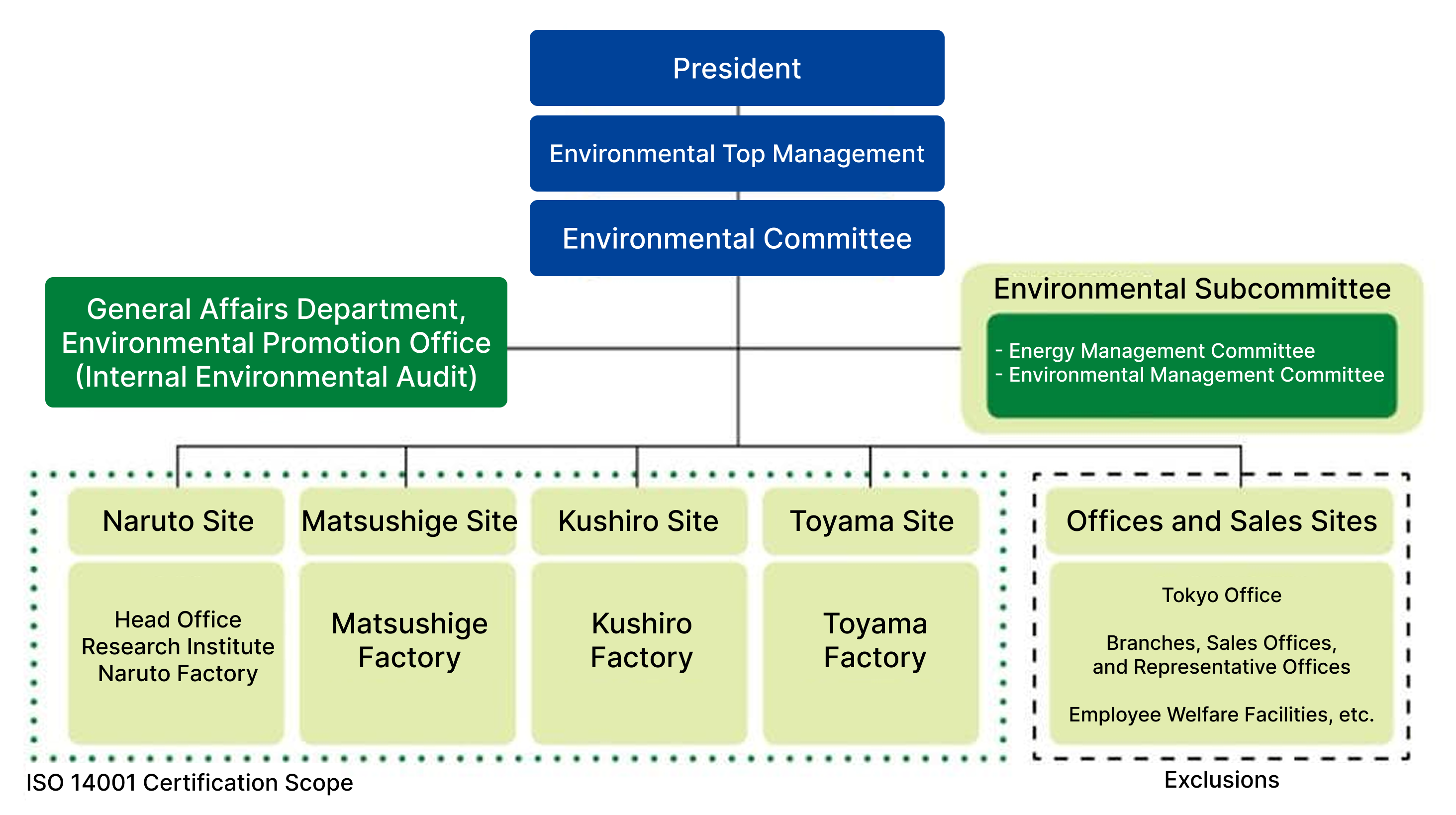
Environmental Management Promotion Framework
Under our environmental management promotion framework, our company is working as one to continuously engage in environmental conservation activities. Based on the Environmental Activity Guidelines formulated by the Environmental Committee—the decision-making body for environmental management—we coordinate with various committees (such as the Risk Management Committee and the Environmental Subcommittee) to implement environmental conservation activities in accordance with the PDCA cycle of identifying issues, setting targets, planning and execution, and evaluating and reviewing activities. We also separate our domestic business offices into five sites; we assign a site leader, an environmental manager, and environmental promotion committee members at each plant site. While each site conducts activities autonomously, we manage environmental conservation activities on a company-wide basis.
ISO 14001 Certification Status
| April 1999 | Toyama Factory | |
|---|---|---|
| September 2002 | Kushiro Factory | |
| May 2003 | Naruto Factory | |
| August 2003 | Matsushige Factory | |
| September 2010 | Integration of four Otsuka Pharmaceutical Factory sites | |
| August 2020 | Acquired integrated certification as the Otsuka Group | |
All of our factories have acquired ISO 14001 certification, the environmental management standard that demands stringent system operations to reduce environmental risks and improve environmental performance. In August 2020, to strengthen initiatives across the entire Otsuka Group, the Otsuka Group acquired integrated ISO 14001 certification.
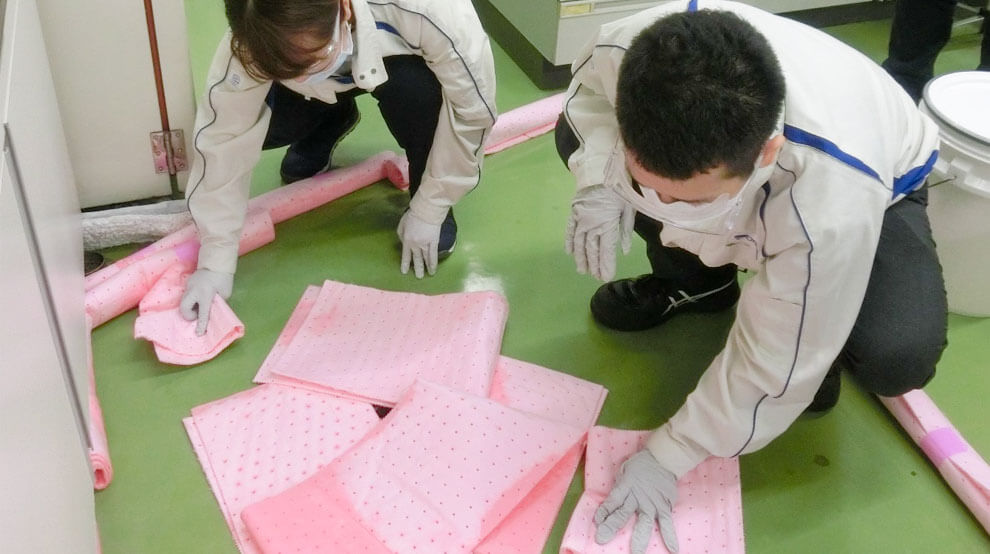
Drill simulating splashed chemical caused by a reagent bottle tipping over
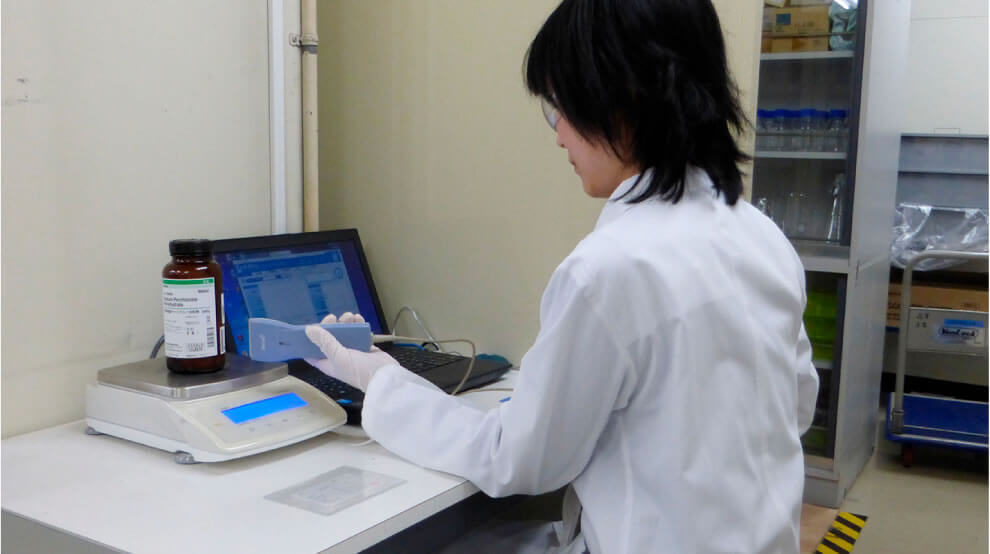
Centralized chemical management system
Environmental Compliance
Reducing environmental risks
We have appointed pollution control managers for air, water quality, and other areas, and
ensure strict compliance with in-house standards that are of a more stringent level than
statutory limits. For chemical substances that may affect people and the environment, the
departments that use them have also developed chemical management systems, and by managing
databases of chemical information and inventories we comply with the PRTR system*5 and the Poisonous and Deleterious Substances Control Act*6, while
properly managing chemicals from purchase through disposal. The status of
environmental compliance is checked regularly through internal environmental audits,
compliance evaluations, and reviews by third-party organizations, and we continue to
work on reducing environmental risks even further. Over the past five years, there
have been no environment-related accidents and no serious violations of environmental
laws and regulations (such as administrative sanctions). To strengthen environmental
governance, we have been participating in environmental audits of our domestic
subsidiaries since 2024. We regularly conduct drills at our sites assuming emergency
situations to prevent and mitigate environmental pollution caused by disasters and
accidents.
- PRTR system: Pollutant Release and Transfer Register. Under this system, business operators identify on their own the quantities of chemical substances that may pose risks to human health or ecosystems that are released from their sites into the environment (air, water, soil) and the quantities that leave the sites contained in waste, report them to the government. Based on the reported data and estimates, the government aggregates and publishes the release and transfer amounts.
- Poisonous and Deleterious Substances Control Act: A law that designates, among useful chemicals distributed in daily life, substances with a high likelihood of health damage primarily due to acute toxicity as poisonous or deleterious and, from the standpoint of public health and hygiene, regulates inappropriate distribution, theft, leakage, etc.
Initiatives based on environmental material issues
Aligned with the sustainability-wide materiality issue of “Promote Positive Impact on Global Environment,” we present concrete activity results on each page for the four themes below and for coexistence with local communities.